What does a walkable new town mean at the edge of metropolitan Phoenix?
Verrado Main Street District was intentionally designed to feel like a cohesive small town. Its tree-lined streets, front porches, parks, shops, recreation, and town square create a form of neighborhood life that is unusual at the expanding western edge of the Valley.
What you can observe while there
Shade feels inherited, even when it is planned.
There are so many tree-lined streets and fallen leaves that the neighborhood can feel like perpetual fall. Abundant natural grass, immaculately kept landscaping, and the same rock used throughout give it a consistent texture. On our visits, we noticed no trash. Homes are organized around park centers, with housing filling the spaces between them. Two distinct styles of tree-lined streets connect these clusters.
Many homes have huge front porches and uniquely designed driveways and walkways. Big yards sit alongside small ones. The housing ranges from townhomes and golf course villas to one- and two-story single-family homes with three to six bedrooms, serving various incomes. As of 2025, construction was still underway, mainly on more expensive homes and townhouses.
The sidewalks carry dates stamped into their concrete: 2003, 2004, and 2014. These small traces of the district’s development sit beside the everyday signs of its residents. On March 1, 2024, we counted 21 American flags, one Iowa Hawkeyes flag, one Georgia Bulldogs flag, and one Ukrainian flag hanging upside down.
Main Street gives the district a center.
The community gathers around a grocery store, food shops, a recreation center, offices, and the town square on Main Street. Townhomes cluster near the stores and schools, reinforcing the feeling of a cohesive small town.
The square hosts regular farmers markets and concerts, with performances noted by Andy Grammer, The Beach Boys, Kool & The Gang, Sugar Ray, and others. Recreational cycling is part of the neighborhood’s life, and the senior community was very active.
On March 1, 2024, around 2:30 p.m., the temperature was about 78°F. We noted two adults out walking, a woman walking dogs, an older man on a bicycle accompanied by an older woman, and a boy riding his bike. These encounters capture a particular afternoon in the district.
Quail and jackrabbits appear among the desert planting. Roses, creosote bush, and lavender lend the streets pleasant smells. These encounters give the district a sensory character beyond its carefully maintained appearance.
School Hill Road brings together The Goddard School, Verrado Middle School, and Verrado Elementary School. Verrado High School sits in the northeast area. The middle school’s entrances sit immediately off the sidewalk, with many windows and architecture that struck us as beautifully old-fashioned. On our visit, we saw no perimeter fencing at those entrances, and the parking lot was behind the building. The school felt connected to the street.
In our field notes, Christ’s Church of the Valley (CCV) was the only religious building within Verrado. A drive of a mile or two brought additional options: Baptist churches, Summit Community Church, and The Church of Jesus Christ of Latter-day Saints.
The mountains frame a connected, yet constrained, edge.
The mountains are always in view, wherever you are in the district. Sunset comes early beside them, while the horizon opens to a grand view of Phoenix and the West Valley.
Litchfield Heights borders the district to the east and Verrado Heritage District to the south. Verrado Golf Club lies to the west. To the north is Victory at Verrado, a community for residents aged 55 and older.
Virtually all traffic leaving Verrado must use Verrado Way or Indian School Road, resulting in regular rush-hour congestion. The few routes out expose the tension between an internally walkable district and a metropolitan life that still requires driving.
Comfort is not the same as cultural depth.
The district performs strongly in protection, affection, idleness, and freedom: it feels safe, cared for, pleasant, and capable of supporting family or retirement. Its weaker dimensions are identity, creation, understanding, and participation. These are the qualities that help residents make meaning together rather than simply inhabit a well-designed place.
This rating is an editorial interpretation of Manfred Max-Neef’s framework of fundamental human needs. It is a lens for inquiry, not an official measure or municipal finding.
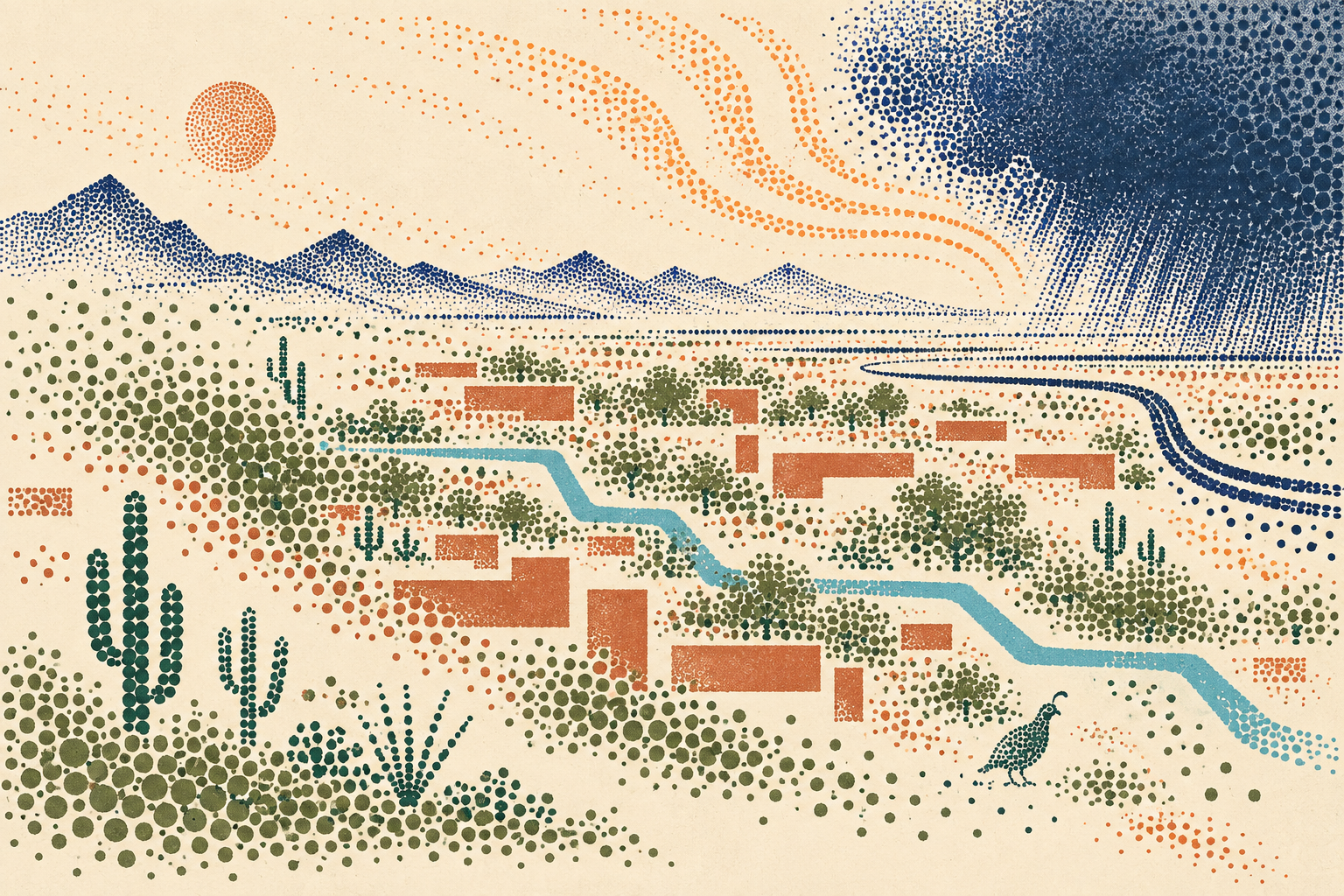
Notes of rose, creosote, and lavender. Quail and jackrabbits, porch flags and bicycles, dates pressed into concrete, and the White Tank Mountains holding the horizon.
Will Verrado remain a comfortable bedroom community, or become a place with a culture of its own?
If current strengths continue without deeper civic and cultural investment, Verrado may become an exceptionally safe, attractive place to raise a family or retire while offering fewer paths toward creative expression and a distinct shared identity.
The founding generation still has leverage. Schools, a future library or community college, public-private partnerships, and locally rooted cultural institutions could turn a carefully designed setting into a place residents actively author together.
Conditions to watch
- West Valley population and housing density
- I-10, SR-303, SR-30, and future I-11 connections
- Schools, libraries, and places for shared learning
- Resident-led arts, traditions, and civic participation