Can a neighborhood full of parks grow a shared identity without a Main Street of its own?
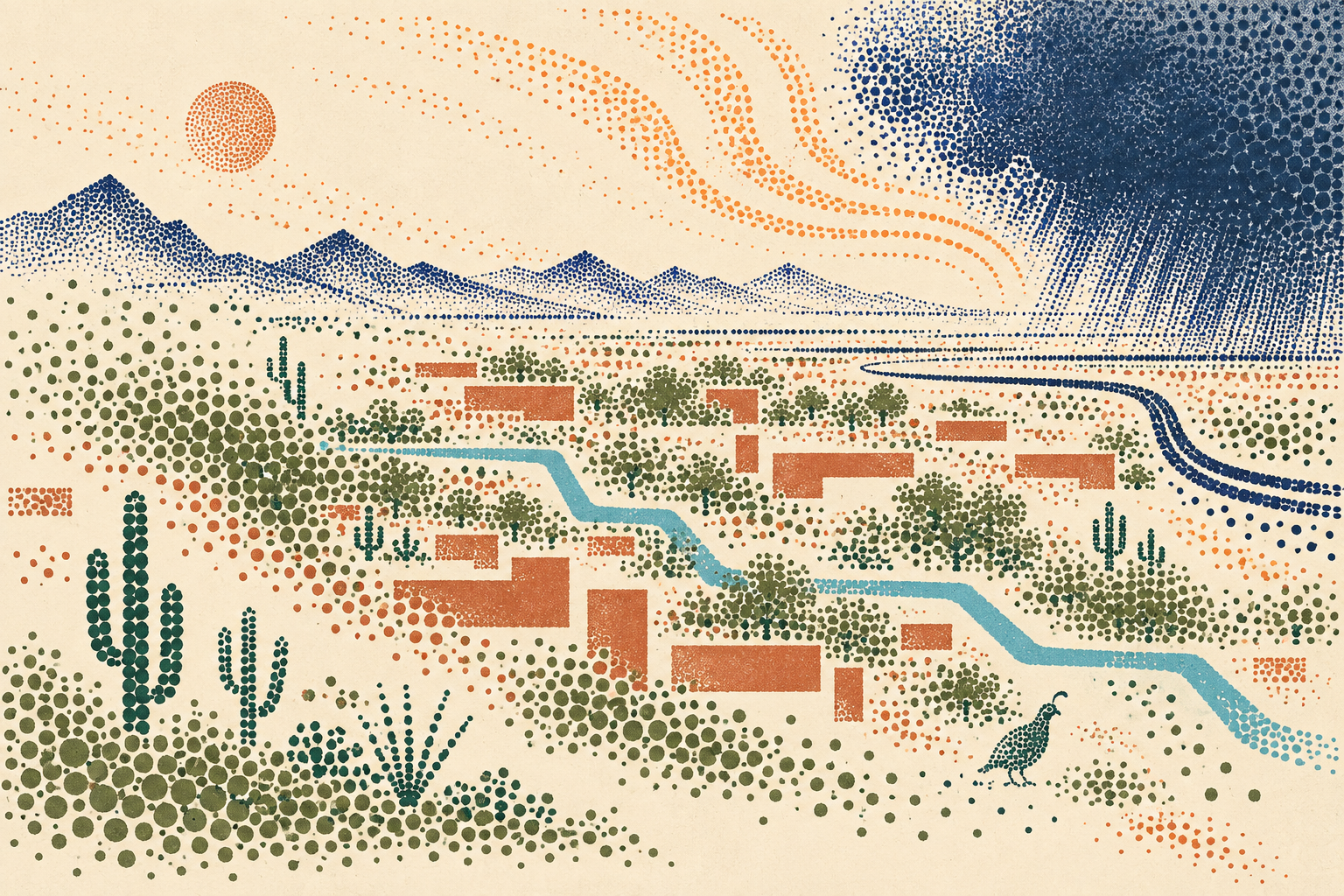
Verrado Heritage District is the portion of Verrado closest to I-10. Tree-lined streets, abundant parks, carefully finished homes, and mountain views offer a comfortable setting for everyday life. Yet the district’s sense of community is still taking shape. As of 2025, homes, commercial retail, offices, and other development remained under construction.
What you can observe while there
The streets carry the details of a place being made.
Beautiful tree-lined streets with seasonal leaves connect a wide range of homes: townhomes, golf course villas, and one- and two-story single-family houses with three to six bedrooms, serving various incomes. Big yards sit alongside small ones. On our visit, we counted four swings hanging from trees in front yards. Even the street names have character, including Wolf Berry Place.
Virtually all the walls are smooth and painted to match the homes. The colors vary, often with a brick accent along the top. Entryways to front doors feature tile and other accents; one home had an entirely tiled patio floor. Most homes have yard art and patio space. We counted three American flags.
Our observations found almost no trash, immaculately kept landscaping, and consistent rock throughout. Some streets have trees along the roadway; others have tree-lined sidewalks with roughly twice the trees. Alleyways include designated spots for garbage bins. A date stamped into the sidewalk concrete, 2005, offers a small record of the neighborhood’s beginnings.
The parks have something to say.
The community is saturated with parks. Poets Park places poetry on stepping stones and includes signage about parenting, family, and life. Compass Point Park turns a playground into a lesson in direction, with north, east, south, and west, plus signs showing the locations and distances of historical cities from Verrado.
Hamiltons Run Park has ramadas shaded by vines. Canyon Place offers a different experience: a large open space of untamed desert with a monument at its entrance. Together, these spaces suggest several ways to spend time outside, from play and reflection to encounters with the desert.
At an awkward street corner, the sidewalk continues into a grassy park with chairs in front of five or six home porches. The arrangement gives those homes a shared outdoor space. The garages appeared to be behind the homes, though we did not confirm that detail.
On a winter visit in 2024, around 1:30 p.m., the temperature was about 60°F. We saw several women walking, four older men on bicycles, a woman collecting her mail, and two men walking dogs, one with two dogs. One child was playing in the street. These small scenes capture the neighborhood at that particular hour.
The number of birds was striking. We saw a roadrunner, a quail family, and jackrabbits, along with snakeskin. Fresh-cut grass, creosote, and lavender give the neighborhood its own mix of scents. These encounters sit alongside the more ordered landscape of maintained parks and residential streets.
Open passages meet a few busy routes out.
The district sits in Buckeye at I-10 and Verrado Way, bordered by Sienna Hills to the west and Verrado Main Street District to the north. Vallarta was the one gated community noted on our visit. Its gates restrict vehicles, while pedestrians can pass freely.
The nearby mountains are almost always visible, wherever you are in the neighborhood. Sunset comes slightly early beside them, giving the district a daily reminder of its position at the Valley’s western edge.
Virtually all traffic leaving Verrado travels along Verrado Way, Thomas Road, or Indian School Road. Regular rush-hour congestion makes these routes an important part of everyday life, even in a neighborhood with so many places to walk and cycle.
A comfortable setting still needs a shared center.
Heritage District’s strongest dimensions are protection, affection, idleness, and freedom. The assessment suggests a place where residents can feel secure and cared for, with room for rest and everyday choice. Its weaker dimensions are identity, creation, understanding, and participation.
In this assessment, Heritage District scores below Main Street District’s 7.55 for one reason: it lacks a Main Street at the core of its own community. The parks provide gathering places, but a shared commercial and civic center offers another kind of connection.
This rating is an editorial interpretation of Manfred Max-Neef’s framework of fundamental human needs. It is a lens for inquiry, not an official measure or municipal finding.
Notes of fresh-cut grass, creosote, and lavender. Front-yard swings, seasonal leaves, poetry underfoot, roadrunners and quail, tiled patios, and mountains catching the last light.
By 2050, will comfort become the foundation for a culture residents create together?
If the current pattern continues without efforts to strengthen its weaker dimensions, our outlook is for a safe, comfortable bedroom community by 2050. High protection and affection scores suggest an appealing place to raise a family or retire, while residents seeking creative fulfillment or distinctive cultural experiences may find fewer opportunities.
Development has been underway since 2005. Twenty years later, in our 2025 observations, the district still felt young, settled and founded by families whose choices will have a lasting effect on its character.
Continued growth in Buckeye and Goodyear will ask Verrado to adapt. Schools and public-private partnerships could help residents build identity and creativity. A nearby library or community college could support shared learning and understanding.
The open question is how much residents will shape these possibilities themselves. Will the district build a stronger culture of work, play, and civic life, or continue primarily as a quiet, safe place to live and retire near Verrado’s golf course and retirement community?
Conditions to watch
- Buckeye and Goodyear growth, including Goodyear’s approach to density
- I-10 and SR-303 improvements, plus proposed I-11 and SR-30 connections
- Cultural influences from California and Mexico
- The West Valley’s evolving culture of work, play, and living
- School partnerships and resident-led creative opportunities
- Access to libraries, a community college, and shared learning