What sustains a neighborhood when its strongest connections have grown over generations?
In The Groves, citrus trees and established families give everyday life a sense of continuity. Neighbors know one another, yards are carefully maintained, and couples and children move through familiar streets. The question is how that continuity will carry forward as residents and families change.
What you can observe while there
The name belongs to the landscape.
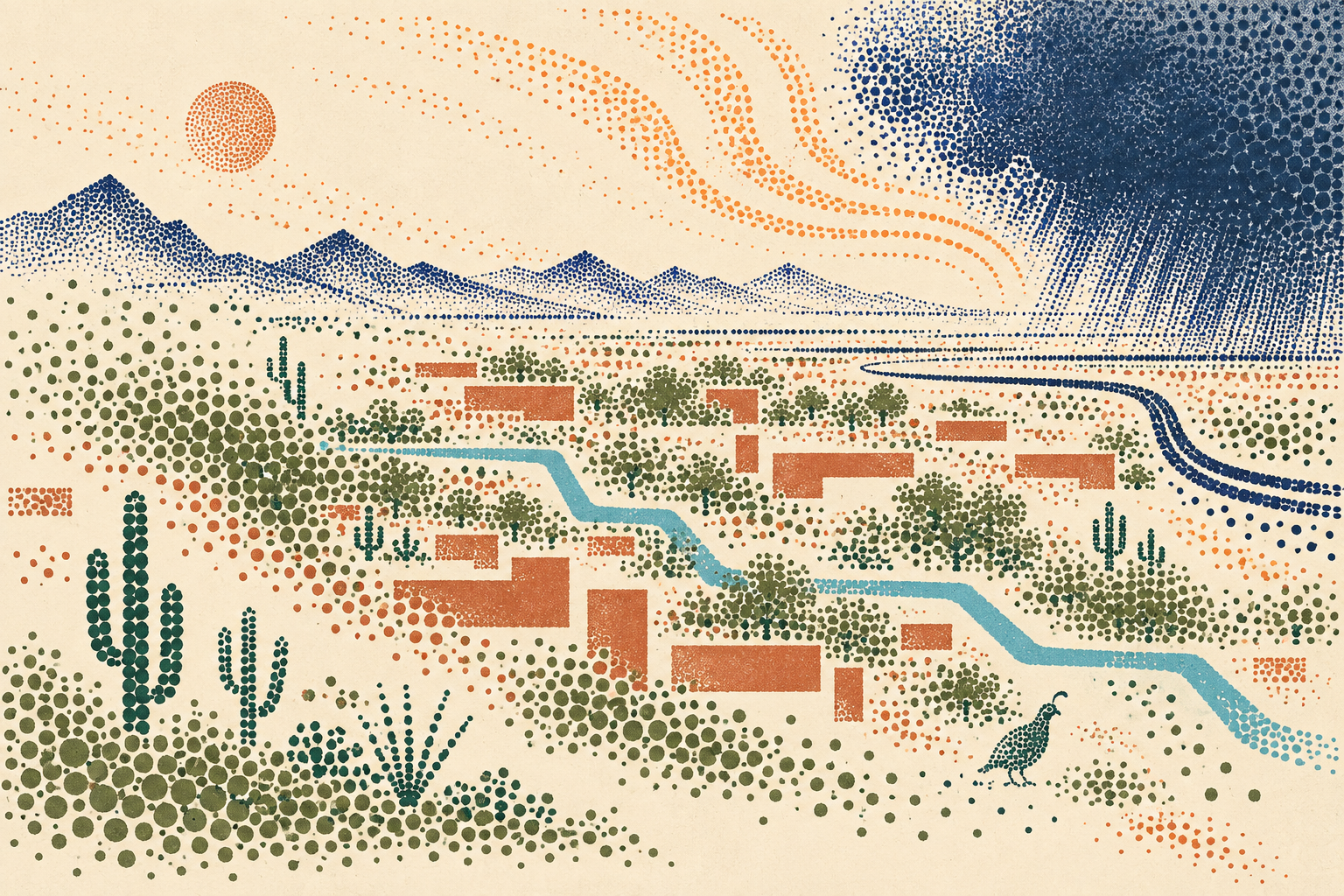
The Groves sits near Val Vista Drive and Brown Road in Mesa, surrounded by other neighborhoods and citrus groves. Many properties maintain citrus trees of their own. Here, the neighborhood’s name has a clear relationship to the landscape residents continue to care for.
The yards are immaculate. Depending on the season, citrus blossoms lend the neighborhood a particularly strong scent. Songbirds are plentiful, and our notes also describe occasional coyotes.
Familiarity is part of everyday life.
Many established families have lived in The Groves for a long time, and it is common for neighbors to know one another. Couples walking together and children riding bicycles or golf carts are familiar scenes.
Our notes describe religious life as an important part of the community, including many residents who are members of The Church of Jesus Christ of Latter-day Saints. Longstanding residents and their large families contribute much of the neighborhood’s observed vibrancy.
A path alone does not resolve access.
The notes identify a canal path, alongside serious concerns about walkability. They do not yet identify the particular crossings, missing connections, or destinations behind those concerns. The distinction matters when considering how residents move beyond their immediate streets.
Parks and churches are the community engagement settings identified in this assessment. Few other mechanisms for gathering, creative work, or shared participation were noted. The assessment characterizes the neighborhood as affluent and suburban, while leaving open how residents themselves experience those limitations.
Strong personal ties leave a question about shared identity.
The Groves’ strongest dimensions are protection, affection, and idleness. Established relationships and a cared-for residential setting support security, connection, and rest. Creation and freedom score poorly in the assessment, with identity the weakest dimension.
That creates a tension: familiarity between neighbors does not necessarily translate into a broader shared identity or accessible opportunities to create and participate. The original assessment suggests affluence may make gaps in local resources less pressing for some residents. Their own perspectives would help test that interpretation.
This rating is an editorial interpretation of Manfred Max-Neef’s framework of fundamental human needs. It is a lens for inquiry, not an official measure or municipal finding.
Notes of citrus blossom. Songbirds, carefully tended yards, couples on walks, children on bicycles and golf carts, and citrus trees carried from one generation into the next.
By 2050, what happens when longstanding families make way for a new generation?
The original outlook anticipates an aging resident community and a substantial change in neighborhood culture by 2050. Its concern is that today’s vibrancy depends heavily on families who have lived here for many years, while weak creation, freedom, and identity scores suggest fewer shared structures to carry that culture forward.
This is an interpretive scenario rather than a demographic projection. The supplied observations do not establish residents’ ages or the pace of household turnover.
The assessment sees the neighborhood’s setting as strongly oriented toward affluent suburban living. As households change, the question is whether newcomers will find ways to build the relationships that established families have accumulated over time.
Walking connections and gathering opportunities beyond parks and churches would be useful subjects for future observation. They could help clarify how the neighborhood’s familiar private life connects to a wider shared identity.
Conditions to watch
- Generational change and continuity among established households
- Maintenance of the citrus landscape and its local meaning
- Walking routes, canal access, and connections to everyday destinations
- Opportunities for gathering, creativity, and participation